Beyond the Booth: Why Today's DJs Need to Speak the Language of Light and Production
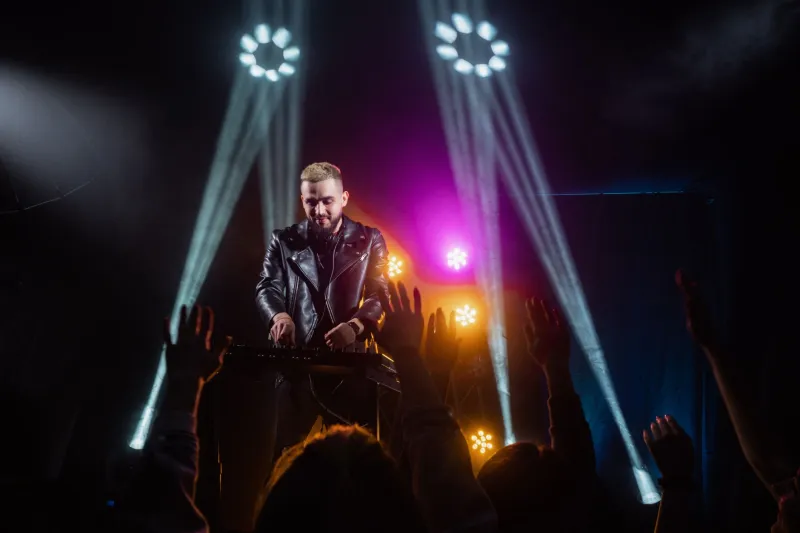
Picture the moment a headline DJ drops the first big record of their set at a major festival. The crowd surges forward. The bass hits. And simultaneously, the lighting rig erupts — strobes cascade, moving heads sweep the crowd, the LED wall behind the booth shifts from deep blue to blinding white. That moment isn't an accident, and it wasn't designed by the DJ alone. It's the product of a collaboration between music and production design that's become one of the defining features of contemporary electronic music performance.
For a generation of UK DJs entering the profession, understanding production design — even at a basic level — has shifted from a bonus skill to something close to a necessity. Here's why, and what it actually means in practice.
How Production Values Transformed the UK Club and Festival Scene
Cast your mind back to UK rave culture in the early '90s. The production was minimal by today's standards — some strobes, a smoke machine, maybe a laser if you were lucky. The music carried everything. That aesthetic persisted well into the 2000s, with warehouse parties and underground clubs deliberately stripping production back as a statement of authenticity.
Then something shifted. As electronic music moved from subcultural to mainstream — Creamfields growing into one of Europe's biggest festivals, fabric becoming a global brand, the superclub circuit expanding — the production arms race began in earnest. Promoters invested in larger rigs, more sophisticated lighting systems, and eventually in the LED technology that now defines the visual grammar of electronic music events.
Today, a headline slot at Parklife, Glastonbury's Park Stage, or London's Printworks involves production values that would have seemed extraordinary even fifteen years ago. Kinetic lighting installations, pixel-mapped LED volumes, projection mapping, real-time visual content synced to MIDI or audio triggers — the technology has evolved at a pace that's left some DJs scrambling to catch up.
What Lighting Designers Actually Do (And Why DJs Need to Understand It)
A lighting designer — or LD — is responsible for programming and operating the visual elements of a show. At larger events, they'll have been working on a production for weeks before the event, designing looks, programming cues, and building a visual narrative that complements the music.
The relationship between an LD and a DJ is fundamentally different from the relationship between an LD and a live band. With a band, the set list is fixed, the song structures are known, and the LD can programme specific cues to specific moments. With a DJ, the set is fluid. Track selection might change in the moment, energy levels shift based on crowd response, and a DJ might decide to extend a breakdown or drop a track early. That unpredictability is part of what makes DJing exciting — but it creates a genuine challenge for production design.
The DJs who work most effectively with lighting teams are the ones who can communicate their intentions in advance. Not with a fixed set list, but with a rough arc: "I'll build slowly for the first forty minutes, push hard from there to the two-hour mark, then drop the energy briefly before the final push." That kind of structural briefing gives an LD enough to work with without constraining the DJ's spontaneity.
Some DJs go further and actively collaborate on visual language — agreeing on colour palettes, identifying specific tracks where particular looks should fire, or flagging moments in their set where they want production to lead rather than follow. That level of collaboration requires a working knowledge of what production can actually do, which means DJs need to educate themselves.
The Technical Basics Every DJ Should Know
You don't need to be able to programme a grandMA console. But a working familiarity with the following goes a long way:
DMX and MIDI. DMX is the standard protocol for controlling lighting fixtures. MIDI is widely used to trigger visual content. Understanding that these systems exist and that they can be synced to audio — either manually by an operator or automatically via BPM detection — helps you have intelligent conversations with production teams.
Moving heads, wash lights, and strobes. These are the workhorses of club and festival production. Moving heads create the sweeping, dynamic looks associated with peak-time moments. Wash lights flood the room with colour and atmosphere. Strobes are the bluntest instrument in the rig — powerful, but easy to overuse. Knowing the difference helps you describe what you want.
LED walls and content. Many larger venues now feature LED video walls or panels behind or around the DJ booth. These display visual content — which might be abstract, reactive to audio, or specifically designed for the event. If you're playing a venue with a significant LED installation, it's worth asking who's managing the content and whether there's an opportunity to have input.
Haze and smoke. Not strictly lighting, but crucial to how lighting looks in a room. Haze (a fine, lingering mist) makes laser beams and moving head effects visible in the air. Without haze, most dramatic lighting effects are significantly less impactful. If you're playing a venue that's stingy with the haze machine, the production will look flat no matter how sophisticated the rig.
Adapting Your Set for Visual Immersion
Production design doesn't just change how a set looks — it changes how it feels, and that has implications for how you structure your music.
In a heavily produced environment, the relationship between musical dynamics and visual dynamics becomes a kind of dialogue. A long, patient build hits differently when the lighting slowly intensifies alongside it. A sudden drop has more impact when the LD has been briefed to kill everything to a single strobe for the preceding eight bars. These moments of synchronisation — when music and light move together — are what audiences remember.
To take advantage of that, DJs playing produced environments often think more deliberately about their set structure. Moments of peak intensity need space before them to build properly. Transitions that might be invisible in a stripped-back room become visible, cinematic events when production is involved. The music still leads, but it leads in conversation with everything happening around it.
Standing Out in an Increasingly Visual Market
Here's the commercial reality: UK promoters booking DJs for produced events increasingly factor in a DJ's ability to work with production teams. It's not the primary criterion — your music still has to be right for the room — but it's a differentiating factor, particularly at the higher end of the market.
DJs who've built a reputation for being collaborative, communicative, and production-aware tend to get re-booked for events where that matters. They're easier to work with, and the shows they're part of tend to be better as a result.
For DJs earlier in their career, the practical step is straightforward: start paying attention to production at every event you attend or play. Notice what the lighting does at different moments in the music. Talk to the LDs working the events you're at — most are happy to chat between sets. Build that vocabulary gradually.
The booth is still where the music lives. But the whole room is where the experience happens. The DJs who understand that distinction are the ones building careers that go well beyond the decks.